If you’re not seeing some images or content, it might be because certain cookies are disabled—most likely the Unclassified Cookies category. To ensure all images and links display properly, please enable the necessary cookies in your Consent Preferences. For more details, you can review our Privacy Policy and Cookie Policy. Please update your preferences to get the full experience!
5 Core Metrics You Should Be Tracking As a SaaS Founder


Buzzwords, buzzwords, buzzwords.
MRR, CAC, LTV…
Always hearing the same old abbreviations.
However, they do make sense and are actually THE core metrics of a SaaS startup.
And if you’re a SaaS founder you should always have a strategy in place to quickly make sense of these metrics.
1) Monthly Recurring Revenue (MRR)
MRR measures the predictable revenue your business generates every month.
It’s crucial for understanding growth and financial health.
Without it, your business just ceases to exist.
To track MRR efficiently I always advise using tools such as Stripe or Baremetrics.
They are the most comprehensive tools on the market that will provide you the ins and outs of your business.

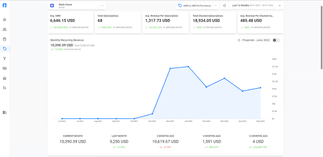
Quick tip: When looking at the MRR chart or any chart from the following ones, try to notice sudden spikes & drops and try to correlate it to a new feature release, platform downtime or some UI changes.
This will help you understand what your users like and dislike.
Double down on what they like.
2) Customer Acquisition Cost (CAC)
Lead generation is the lifeblood of any SaaS business.
Most of the metrics mentioned here are direct byproducts of lead gen processes.
CAC measures the cost of acquiring a new customer, helping you assess the efficiency of your marketing and sales efforts.
It’s directly correlated to LTV, which I’ll get to in a second.
Your goal should always be to keep your CAC low and your LTV high.
So how to track your CAC:
Combine marketing expenses and the number of new customers acquired within a specific period.
CRM tools such as HubSpot or Pipedrive can help track marketing costs and lead sources, while Google Analytics can measure conversion rates.
Learn to make a connection between the 2 and you’ll always be on top of your CAC game.

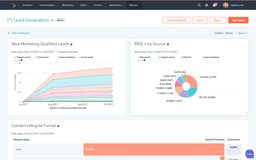
A rising CAC might indicate that you should change your marketing approach.
3) Customer Lifetime Value (CLTV)
As mentioned in CAC, CLTV, or LTV for short is directly related to CAC.
CLTV represents the total revenue you can expect from a single customer account.
It helps in understanding the long-term value and sustainability of your customer base.
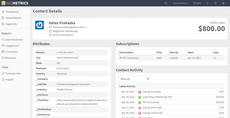
Some tools that are helpful in tracking CLTV are Kissmetrics, Salesforce or Segmetrics.
Naturally, you want to increase your CLTV as much as possible, in order to gain as much value from a single account.
But your platform also needs to give them something in return and constantly be updated and improved.

4) Churn rate
A churn rate indicates the percentage of customers who cancel their subscriptions within a given period.
High churn rates can be detrimental to growth.
To maintain a healthy churn rate, you should aim to keep it under 3%.
If you notice churning trends, this should be your main indicator that you’re doing something wrong.
Implement “exit interviews” and feedback forms to understand why your customers are leaving.
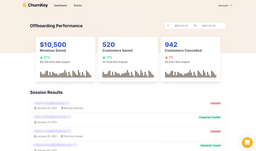
Churnkey is a great tool that can help you retain your users and decrease your churn rate.
They have a straight-to-the-point UI with ROI showcasing that always helps you understand how much money you saved by using Churnkey.
A big plus!

5) Net Promoter Score (NPS)
Referrals are one of the best strategies when it comes to growing a business.
I think that one week doesn’t go by that I don’t write a post about referrals.
So here we are:
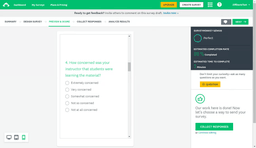
NPS measures customer satisfaction and loyalty by asking customers how likely they are to recommend your product to others.
To implement a high-quality feedback loop inside your SaaS try using tools such as SurveyMonkey or Typeform in order to collect regular feedback, prevent churn, and increase your chances of customer acquisition.
This strategy could be your biggest leverage since it requires low investment, thus reducing CAC.

I hope you enjoyed this blog post, and that it helped you find the right metrics to track.
Remember: while a specific metric may help you see things in your own perspective, think about if it’s just a vanity metric.
Stay connected, stay informed
Navigation
Useful links
Our Motto
Our success is fueled by strong partnerships. Together, we innovate, excel, and deliver work that works.Trusted by